
 Sign in
 Sign up


Drone Optical Flow Positioning : How It Works & When It Fails | Holy Stone
How it works, why altitude hold isn't the same as staying in place, and when optical flow may struggle.
Why can a drone hold its height yet still slide left or right? The answer is that altitude hold and horizontal position hold are different jobs. Optical flow positioning can help a drone detect movement across the ground and correct some of that sideways drift—but only when the camera can see a suitable surface.
This guide explains the difference in everyday language, shows where optical flow may struggle, and offers a practical checklist for new pilots. The principles apply broadly to visual-positioning drones; exact operating heights, sensor combinations and fallback behavior depend on the model and its manual.
Quick answer: Altitude hold helps maintain height. Optical flow measures apparent movement of the ground beneath the drone and can support horizontal hover corrections. Neither means a drone is guaranteed to stay perfectly still, and optical flow is not GPS or obstacle avoidance.
What Is Optical Flow Positioning on a Drone?
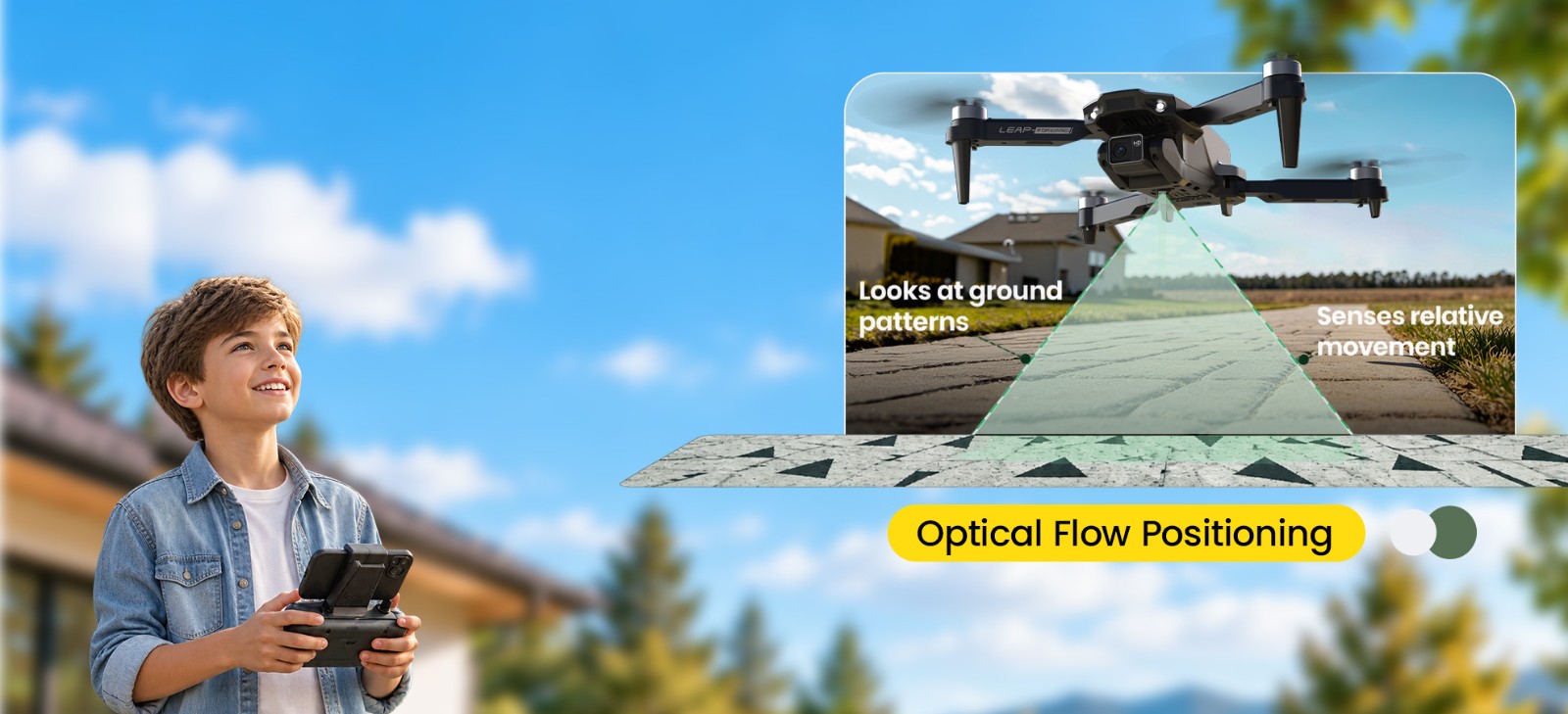
Optical flow is a way of estimating movement by comparing successive images. A downward-facing camera sees small features—a patch of grass, a crack in a path, the weave of a carpet—and detects how those features shift in the camera’s view as the drone moves.
With the right flight-control system and supporting sensor information, this relative-motion estimate can help the drone reduce unwanted movement during low-altitude hovering. It does not reveal the aircraft’s location on a world map.
Observe
The downward-looking camera sees recognizable details on the surface.
Estimate
The system compares image frames to estimate motion relative to the ground.
Assist
When tracking is reliable, flight-control adjustments may help limit horizontal drift.
Concept diagram only. Actual optical-flow hardware and control logic vary by model.
For a broader look at how sensors work together, read Flight Control System — Drone Systems Explained.
Optical Flow vs Altitude Hold: What’s the Difference?
Imagine a drone suspended above a lawn. It can stay roughly the same distance above the ground yet slowly move toward a fence. That is possible because controlling height is not the same as controlling horizontal position.
Altitude Hold
Primary question: Am I rising or falling?
Helps regulate vertical movement and maintain an approximately consistent height. Implementations vary; many flight controllers use a barometer and may also use distance sensing.
Does not by itself prevent: drifting left, right, forward or backward.
Optical Flow Assistance
Primary question: Am I moving relative to the visible ground?
Uses changing image details to estimate horizontal movement and may assist the controller in reducing drift when tracking is reliable.
Does not provide: GPS coordinates, obstacle detection or a guarantee of stationary hovering.
Helps the aircraft maintain approximately the same flight height.
Estimates horizontal movement from visible ground patterns to support drift correction.
Same height ≠ same place. A drone may have altitude hold without a reliable horizontal positioning system. If optical flow is lost, the aircraft may maintain height while drifting with wind or other disturbances, depending on the model.
When Does Optical Flow Positioning Work Best?
Optical flow needs the camera to pick out details and follow them consistently. Think of a person trying to track movement in a video: a well-lit, textured scene is much easier to follow than a plain white wall.
Good, even lighting
Enough light helps the downward camera distinguish useful features without deep shadows or glare.
Visible surface detail
Paths, well-defined ground textures and carpets with distinct patterns can offer recognizable features.
Suitable low-altitude range
Use the height range given for your model. The useful range depends on the camera, field of view, lighting and any supporting sensors.
Gentle movement and calm conditions
Moderate motion and low wind make it easier for the system to maintain usable image tracking.
What about grass? Grass can provide helpful visual texture in good light, but appearance varies. Uniform lawns, moving blades in strong wind and deep shadow can make tracking less reliable. A surface type is not an unconditional guarantee.
When Does Optical Flow Become Unreliable?
A sensor can be functioning correctly and still struggle because the surface does not offer stable visual information. These are common situations to avoid or approach with additional caution.
Blank or uniform surfaces
Plain floors and large areas of nearly identical color may provide too few unique features to follow.
Water, glass or glossy floors
Reflections and transparency can make the scene appear to move independently of the surface.
Darkness, glare or rapid changes
Weak contrast or sudden exposure changes may disrupt tracking.
Moving or repetitive patterns
Flowing water, swaying plants, crowds or identical repeating tiles can produce misleading visual motion.
What Can the Downward Camera Track?
These are general tendencies, not HS200P-specific field tests. Even a textured surface can become unsuitable when lighting, wind or motion changes.
Textured carpet
Distinct patterns under even light can provide useful visual features.
Grass or pavement
Visible detail can help, but swaying grass, wind, shadows and plain concrete can interfere.
Identical tiles or uniform floors
Repeating or featureless areas may make movement harder to estimate.
Water, mirrors or glass
Moving reflections, transparency and glare can produce unreliable visual cues.
What Happens When Optical Flow Stops Helping?
The camera recognizes patterns and estimates their movement.
Darkness, reflections, poor texture or unsuitable height can reduce confidence.
Horizontal position assistance may weaken. Drift can increase, even if height is still maintained.
Some models may revert to altitude-hold-type behavior when optical flow becomes unavailable. The exact response depends on the aircraft and flight controller. Follow your model's manual and land safely if control becomes unpredictable.
Important: Optical flow is not an obstacle-avoidance system. A drone may still collide with a fence, branch, wall or person, even while its visual-positioning assistance is working.
Strong wind, high-speed movement, a dirty sensor, or flying outside the manufacturer's recommended optical-flow height can also reduce effectiveness. As a concrete example, some Holy Stone manuals describe an approximate low-altitude operating range of 1.6–9.8 ft for their optical-flow modes. Do not treat this as a universal specification for every drone; check the manual supplied with your aircraft.
Why Does My Drone Drift Even with Optical Flow?
First identify what kind of movement you are seeing. Sideways drift, a sudden tilt, and slow changes in height can have different causes.
1. Check the environment
Is the surface reflective, very plain, moving or poorly lit? Are you indoors near airflow or outdoors in gusty conditions?
2. Check your flight mode and height
Confirm whether optical flow is available for your model and whether you are within the manual’s recommended operating conditions.
3. Inspect the aircraft
With the drone powered off, check the downward sensor for dust or damage, inspect propellers and follow the manufacturer’s maintenance instructions.
4. Land before trying again
Move to a clear, textured and well-lit test area, and try a brief low-altitude hover while remaining ready to correct and land. Never test near people, obstacles or water.
What Type of Drift Are You Seeing?
Start with observable symptoms rather than assuming the optical-flow sensor is faulty.
| What you notice | What to check first |
|---|---|
| Slides left, right or backward | Wind, remote stick input, tracking surface, flight mode and propeller condition. |
| Stays at one height but moves sideways | Altitude hold may be active without reliable horizontal position assistance. |
| Sudden movement after takeoff | Ground texture, lighting changes, nearby airflow and model-specific initialization instructions. |
| Moves up and down | Altitude sensing, airflow, control input and environmental conditions—not only optical flow. |
| Good indoors, drifts outdoors | Wind, light, ground motion and differences in positioning mode. |
Sideways sliding: weak visual tracking, wind or flight-mode limitations may be involved. Up/down changes: altitude-sensing conditions, airflow or control inputs may matter. Continuous pull to one side: inspect physical condition and follow model-specific troubleshooting. Avoid assuming every problem is caused by optical flow.
If the drone continues to behave unpredictably under suitable conditions, stop flying and consult the official troubleshooting guide or support team rather than repeatedly attempting takeoff.
Optical Flow vs GPS: Which Matters for Beginners?
These technologies solve different positioning problems. Depending on the drone, they may complement each other rather than compete.
| Question | Optical flow positioning | GPS / GNSS positioning |
|---|---|---|
| What information does it use? | Apparent movement of visible ground features | Satellite-derived position information |
| Where is it useful? | Suitable, textured, well-lit near-ground environments | Outdoor areas with reliable satellite reception |
| Works indoors? | Potentially, if lighting, surface and model permit | Usually unreliable without adequate satellite reception |
| Provides world coordinates? | No | Yes, when a reliable position fix is available |
| Guarantees a stationary hover? | No | No |
A beginner flying a compact non-GPS drone can benefit from optical-flow assistance in suitable environments, while GPS-equipped drones may offer additional outdoor navigation functions such as model-dependent Return-to-Home. Neither replaces basic piloting skills or visual line of sight.
A Beginner’s Optical Flow Flight Checklist
Before takeoff
Choose an open space, read the age and safety instructions, check battery and propellers, and keep the downward sensor clean.
Choose the surface
Prefer ground with visible details. Avoid water, mirrors, uniformly colored floors and moving surfaces.
Check light and wind
Fly in steady, adequate lighting and calm weather. Avoid rapidly changing shadows and strong airflow.
Practice gently
Start with a brief hover within the model's recommended range. Stay within sight, keep hands on the controls and land if tracking becomes unreliable.
What this means for the Holy Stone HS200P
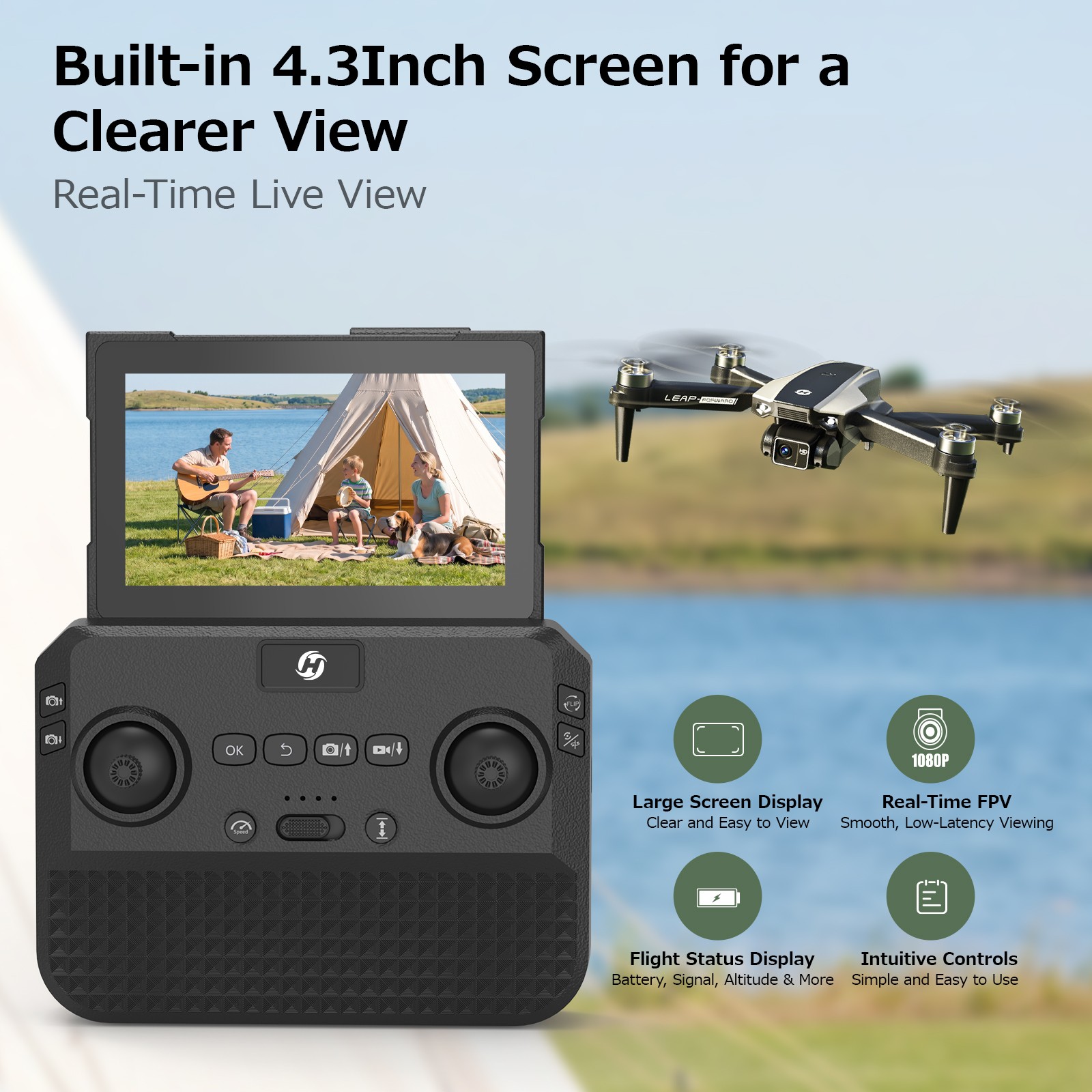
The HS200P brings a downward optical-flow positioning feature into a beginner-oriented drone with a built-in 4.3-inch screen remote. Families can view the camera feed on the included controller without needing to provide an additional smartphone for everyday flying.
Optical flow can assist low-altitude hovering in appropriate conditions, but it is not GPS, cannot detect obstacles and does not eliminate the need for active supervision. Actual behavior depends on the environment and the product instructions.
See Optical Flow in Everyday Beginner Drones
These three Holy Stone non-GPS models combine beginner-friendly controls with optical-flow assistance. Choose by where and how you plan to practice—not by expecting GPS-like position lock.
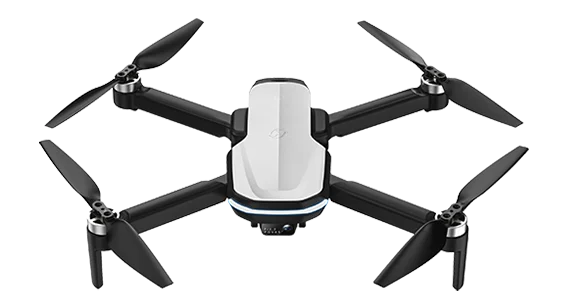
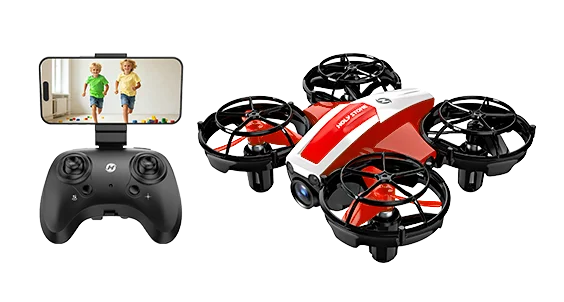
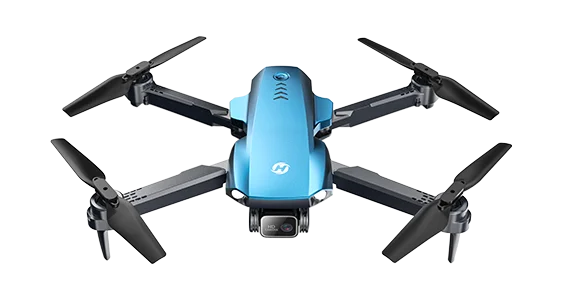
HS290
A 1080P camera drone with one-tap beginner controls and optical-flow assistance; an approachable choice for learning how stable hovering depends on the environment.
Optical Flow + Altitude HoldFeature availability, operating height and fallback behavior depend on each model's instructions and flying conditions. Optical flow is not GPS or obstacle avoidance. Product availability varies by market.
Frequently Asked Questions
Does altitude hold mean my drone will hover in one place?
No. Altitude hold primarily helps maintain height; horizontal drift may still occur unless a separate positioning system can correct it.
Can a drone without GPS hover?
Yes, depending on its control system and environment. Some non-GPS drones use optical flow to assist low-altitude hovering, but they can still drift.
Does optical flow work on grass?
It may work when the grass has visible detail and adequate light. Very uniform grass, strong wind or moving blades may make results less reliable.
Does optical flow work over water?
Water is generally a poor choice because reflections and surface motion can confuse visual tracking. Avoid flying above water unless the manufacturer explicitly supports and provides instructions for that use.
Can optical flow work at night?
Low light can make ground features difficult to detect. Some systems provide illumination, but capability depends on the specific model; consult its manual.
How high can optical flow positioning work?
There is no universal height. It depends on the sensor and aircraft. Follow the manufacturer's supported operating range; for certain Holy Stone modes, documentation cites approximately 1.6–9.8 ft.
Is optical flow the same as obstacle avoidance?
No. Optical flow estimates relative image motion. It does not mean the drone can recognize and avoid objects in its flight path.
Why is my drone drifting to one side?
Possible causes include unsuitable ground texture, wind, lighting, flight-mode limitations or a physical issue. Land safely and follow the model-specific inspection and troubleshooting steps.


COMMENTS