

 Sign in
 Sign up


Power System – Drone Systems Explained 3
Power System (Battery & Power Delivery)
The drone’s Power System is the part that stores, delivers, and manages electrical energy. It includes the battery pack, electronic speed controllers (ESCs), power distribution wiring, connectors and cables, and the monitoring and protection circuits that keep everything safe. Together, these components decide how long the drone can fly and how reliably the motors receive clean power.
Part 1Battery Pack – Flight Time, Smart Safety & Charging ↑ Back
What – What is the battery pack?
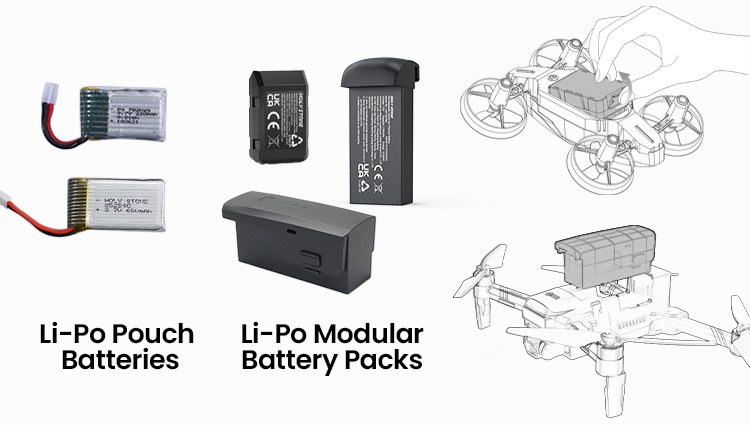
The battery pack stores the electrical energy that keeps a drone flying
A drone battery pack is a rechargeable unit that supplies power to the motors, camera, flight controller, GPS, and lights. Without a battery, the drone cannot lift off or stay in the air.
The most important idea related to batteries is flight time. This means how long one battery can keep the drone flying before it must land. Flight time depends on many factors – battery size, drone weight, flying speed, temperature, wind, and video recording.
Common flight time ranges in consumer drones:
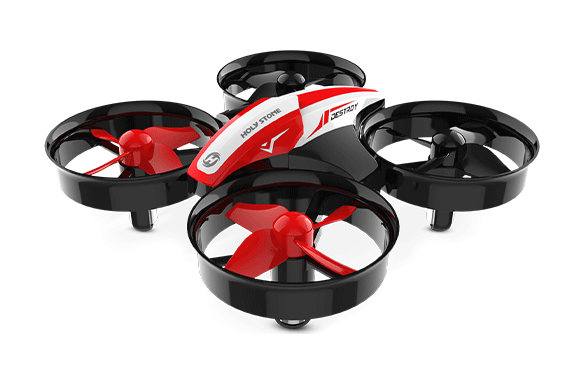
Mini toy drones: 5–10 minutes
Beginner non-GPS drones: 12–18 minutes
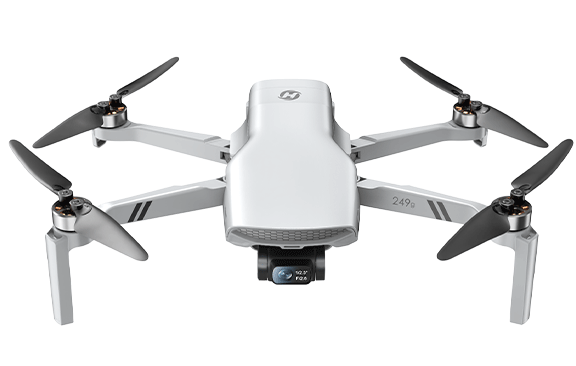
249g GPS camera drones: 20–30 minutes
Larger camera drones: 30–40 minutes or more
Flight time in advertisements is usually measured under ideal test conditions. Real outdoor flight times are almost always shorter.
Battery features to look at when choosing a drone:
| Concept | What it means | Simple analogy |
|---|---|---|
| Capacity (mAh) | Shows how much electric charge the battery can store. A higher number can support longer flight, as long as the drone is not too heavy. | Like how much water a bucket can hold. 1,000mAh is a small bucket, 3,000mAh is a bigger bucket that can supply water for longer. |
| Energy (Wh) | Total energy of the battery, calculated from voltage and capacity. A better way to compare real flight potential between different batteries. | Like how long one full bucket of water can be used to water plants. Higher Wh means you can “water” (fly) for a longer time, not just store more water. |
| Voltage (e.g. 7.4V vs 11.1V) | Defines the power level of the system and affects motor speed, thrust, and how much current is needed for the same power. | 7.4V is like riding a bike in a low gear – smooth and enough power for light use. 11.1V is like a higher gear – stronger push and faster speed, especially helpful in wind. |
| Battery count (1 vs 2 batteries) | Tells you how many full batteries are provided, which affects total flying time in one session. | One battery is like bringing one full water bottle – when it is empty, you must stop. Two batteries are like bringing two bottles, so you can keep going much longer without refilling. |
| Cell structure (2S vs 3S) | Shows how many cells are connected in series inside the pack. More cells give higher voltage and stronger power output. | 2S (about 7.4V) is like a two-step pump – it pushes water reliably with moderate force. 3S (about 11.1V) is like a three-step pump – it builds higher pressure and can spray water farther and harder. |
| Chemistry (Li-ion vs Li-Po) | Describes the battery material system, which affects weight, energy density, discharge ability, and lifetime. | Li-ion is like a big water tank – it stores a lot of water and can supply for a long time, but the flow is softer. Li-Po is like a pressure sprayer – it holds less water, but the spray is stronger and faster. |
| Smart battery (with BMS) | A battery with built-in electronics to measure charge level, balance cells, and help protect against damage. | Like a bucket with clear markings and a safety valve – you can see how much water is left and avoid spills or overfilling. A non-smart battery is like a plain metal bucket where you must guess. |
| Discharge rate (C-rate: high C vs low C) | Shows how quickly the battery can safely release its power for climbs, fast moves, and strong wind. | A high C-rate is like a thick hose that can blast out a lot of water very quickly. A low C-rate is like a thin hose that only allows a gentle stream of water. |
| Battery weight (light vs heavy) | Heavier batteries can store more energy but make the drone work harder to stay in the air, which can reduce efficiency. | Like hiking with or without a heavy water backpack. Carrying more water lets you go longer, but it also makes every step more tiring. |
| Temperature behavior (cold vs hot) | Shows how much battery performance changes in cold or hot weather, affecting flight time and safety. | In the cold, it’s like water turning slushy and flowing slowly, so the drone flies for a shorter time. In extreme heat, it’s like water steaming away faster, which can age the battery more quickly. |
Why – Why does the battery pack matter?
The battery has a strong impact on the whole flying experience. A good battery means longer flights, safer returns, and smoother power delivery. A weak or poorly cared-for battery shortens flight time and increases risk.
Flight time depends directly on how much energy the battery can safely provide.
Performance depends on stable voltage, so the motors and camera get steady power.
Safety depends on keeping the battery within a healthy range, not too full and not too empty.
How – How should drone batteries be used and stored?
Simple habits can help drone batteries last longer and stay safer to use:
Before flying: use batteries at room temperature and avoid taking off with very low charge.
During flying: try not to drain the battery to 0%. Most pilots recommend landing around 20% remaining.
After flying: if you will not use the drone for weeks, store the battery at about 40–60% charge, away from extreme heat or cold.
Following these steps helps keep the battery healthy, improves safety, and protects long-term flight performance.
Extra – Common questions about drone batteries
Q: Why can’t drones fly for a very long time?
A: Drone motors use a lot of power to keep the aircraft in the air. To protect the battery, the drone needs to land before the battery is completely empty.Q: Why is real flight time shorter than the number in ads?
A: Advertised flight time is tested in perfect conditions, usually indoors with no wind. Outdoor flights have wind, speed changes, and video recording, which all use more power.Q: Is it safe to fly until the battery reaches 0%?
A: No. Very low charge can damage the battery and may cause sudden power loss. It is safer to land when the battery is around 20%.Q: Why store batteries at about half charge?
A: Keeping batteries at around 40–60% charge during long breaks reduces stress on the cells and helps them age more slowly.Q: Does cold weather reduce flight time?
A: Yes. Lithium batteries work less efficiently in cold temperatures, so the drone will usually fly for a shorter time in winter.
Power Monitoring, Charging Safety & Smart Battery
This part covers everything related to reading battery status during flight, and protecting the battery during charging and storage. It helps pilots understand remaining endurance, avoid unsafe power levels, and improve long-term battery health.
What – What is power monitoring & battery safety?
Power Monitoring & Battery Safety = Knowing how much energy you have, and how to protect it
This system covers everything related to reading battery status during flight, and protecting the battery during charging and storage.It helps pilots understand remaining endurance, avoid unsafe power levels, and improve long-term battery health.
Why – Why is this important for every drone pilot?
It prevents harmful over-discharge that can reduce battery lifespan or trigger sudden shutdown.
It extends battery life through healthier charging and storage habits.
It improves flight safety by reducing risks such as overheating, swelling, or abrupt power loss.
How – How does it work in real use?
During flight (Power Monitoring)
Check live battery percentage on the app or controller screen to judge remaining flight time.
Low-battery alerts and Return-to-Home automation help avoid emergency landings.
Before & after flight (Charging & Care)
Always use the original charger, and allow hot batteries to cool before charging again.
For long-term storage, keep batteries around 40–60% charge to slow chemical aging.
Fast charging requires the correct battery protocol, sufficient charger wattage, compatible cable, and proper temperature. Otherwise, charging will not accelerate.
With good monitoring in the air and proper care on the ground, batteries deliver longer, safer, and more reliable flight performance.
Extra – What is a Smart Battery (BMS), and why does it matter?
Some mid-range and high-end drones use a Smart Battery with an internal Battery Management System (BMS) — a tiny onboard computer that monitors health and protects the cells.
Typical Smart Battery functions include:
Accurate percentage display instead of guessing by LED lights.
Automatic storage mode — unused full batteries slowly drop toward 40–60% to reduce aging.
Charge and discharge protection against over-charge, over-discharge, and temperature extremes.
Important Note:
If a full battery drops to around 40–60% after sitting for several days, this is a self-protection feature, not damage, and not a defect.
Don’t Misunderstand:
Many users think “the battery lost charge by itself” is a fault, but this is called automatic storage mode, designed to slow long-term aging.
Reality Check:
Not all drones have Smart Batteries. Basic batteries do not self-discharge and must be manually stored at 40–60% by the user.
Extra – 9 real-world battery facts every pilot should know
1. Temperature affects everything:Cold reduces voltage, flight time, and thrust; heat speeds aging and may restrict fast charging or takeoff.
2. Flying fast drains power faster:High-speed moves massively increase current draw, reducing endurance.
3. Added weight reduces endurance:Filters, guards, gimbals, and accessories increase load and shorten flight time.
4. Hovering uses more energy:Holding position requires constant thrust, usually consuming more power than smooth forward flight.
5. Low battery levels are risky:Flying below 5% risks sudden shutdown; land around 20–30%.
6. Wind changes power draw:Headwinds increase current demand; tailwinds make return flights more efficient.
7. Fast charging needs full support:The battery, charger wattage, cable, and temperature must all match — or speed will fall back to normal.
8. Storage charge prevents damage:Long-term full or empty storage accelerates wear; 40–60% is ideal for resting batteries.
9. Real flight time is shorter than ads:Wind, temperature, flying style, weight, and video recording typically reduce endurance by 15–35%.
Part 2ESC – Electronic Speed Controller ↑ Back
What – What is an ESC (Electronic Speed Controller)?
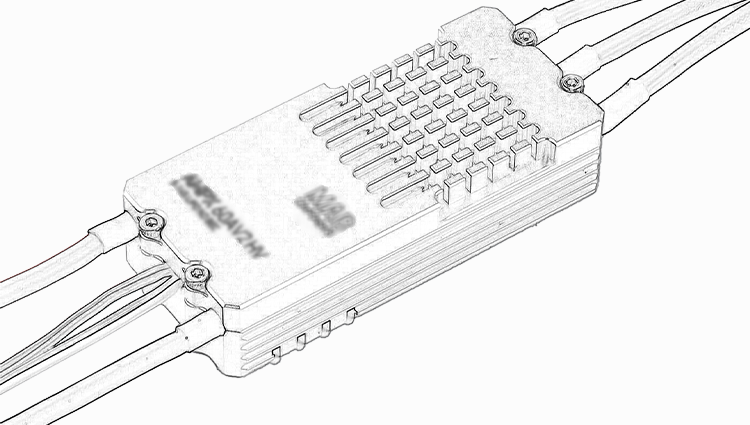
ESC = An electronic system that controls motor speed and power output, acting as the “power translator” between the battery and the motors.
The ESC (Electronic Speed Controller) receives flight-control commands and converts them into fast, precise electrical signals to drive each motor. It enables the drone to take off, hover, turn, brake, and hold stable flight attitude.
In brushless drones, each motor typically has its own dedicated ESC channel. For example, a quadcopter uses four ESCs that work together to deliver stable and responsive flight performance.
Important note: Brushless motors require dedicated ESC units to operate, while brushed motors also rely on speed control—but this circuitry is usually built into the main flight board, so users do not see a separate ESC module.
Why – Why is the ESC critical for smooth flight control?
The ESC regulates each motor’s RPM and thrust output, directly affecting ascent, descent, rotation, and braking control.
A high-quality ESC reacts within milliseconds to assist the flight controller in correcting tiny attitude deviations, resulting in smoother hovering and more precise turns.
ESCs also include multiple protection functions such as over-current, over-temperature, and short-circuit protection to safeguard the power system.
Impact – What role does the ESC play in real flight performance?
ESCs have a direct impact on overall flight quality and handling feel, primarily through the following aspects:
Stability – Precise RPM control allows the drone to hover steadily and execute smooth directional changes.
Response speed – Takeoff punch, braking performance, and wind resistance are closely related to ESC reaction speed.
Efficiency – A high-efficiency ESC reduces energy loss, helping actual flight time match rated endurance more closely.
Reliability – Current and temperature management lowers overload risk and extends motor and system lifespan.
This is why two drones with similar specifications may feel completely different in the air — the ESC quality often makes the difference.
How – How does an ESC operate inside each control loop?
During each control cycle, the flight controller sends explicit RPM commands to the ESC (e.g., “Motor #1 power: 65%”). The ESC then drives the motor coils through rapid voltage switching.
This process is typically based on PWM or FOC motor control. By adjusting pulse timing and duty cycles, the ESC enables smooth acceleration and deceleration, resulting in quieter, more stable, and highly efficient motor operation.
Part 3Power Distribution – Wiring, Connectors & Clean Power ↑ Back
What – What is power distribution?
Power Distribution = The “electrical roads” inside the drone
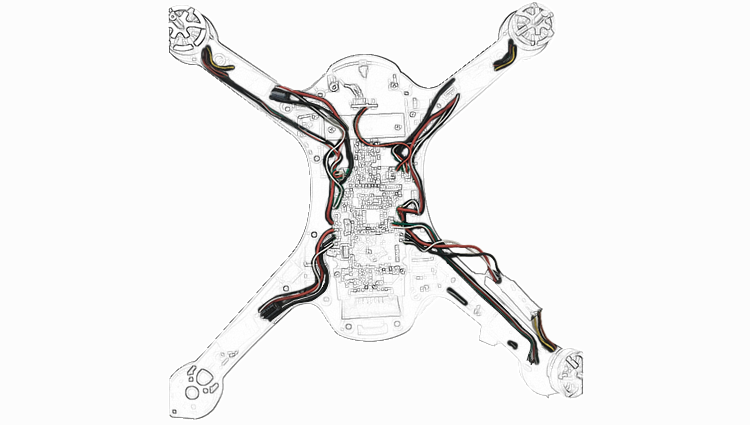
Power distribution is the network of boards and thick copper wires that carry battery power to each ESC, motor, and low-voltage module. Many drones use a Power Distribution Board (PDB) or a combined flight-controller-plus-PDB board.
Why – Why does clean power distribution matter?
Proper wire thickness prevents overheating during high-current climbs.
Good layout reduces electrical noise that could disturb the GNSS, compass, or FPV signal.
Built-in voltage regulators can provide stable 5V or 12V for cameras, receivers, and LEDs.
How – How does power flow through the drone?
From the battery connector, power first enters the power distribution board. Thick traces or wires branch out to each ESC and motor. At the same time, smaller regulators step the voltage down to levels suitable for the flight controller, camera, gimbal, and other electronics.
This layout makes sure that even during full-throttle maneuvers, every part of the drone still receives enough voltage to keep working correctly.
Connectors & Cables – Plugs, Current Paths & Contact Reliability
Along with the distribution board and wiring, connectors and cables decide whether power reaches the motors cleanly and reliably. A small contact problem can create voltage drop, heat, and sudden power loss.
What – What are power connectors and cables?
Connectors & Cables = The plugs and paths that carry current
Connectors are the plastic-and-metal plugs that let you easily attach and remove the battery or modules. Power cables are the insulated copper wires that link everything together.
Why – Why do small connectors matter so much?
A loose or damaged connector can instantly cut power and cause a crash.
Undersized cables can get hot and waste energy as heat.
Good contact surfaces reduce voltage drop, helping motors produce full thrust.
How – How should pilots care for connectors and cables?
Before flight, pilots should check that the battery plug clicks firmly into place and that no cable insulation is broken or pinched between parts of the frame. After many flights, slightly dark or loose connector pins can be cleaned or replaced to keep the power path healthy.


COMMENTS