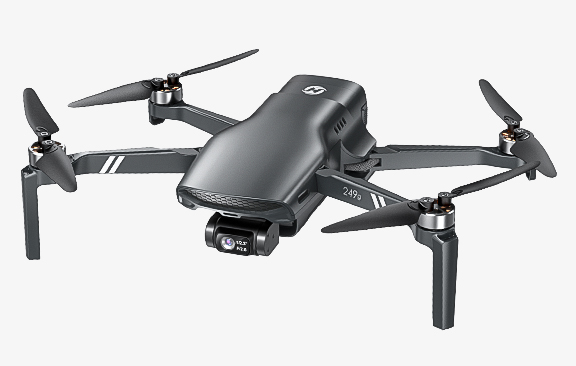
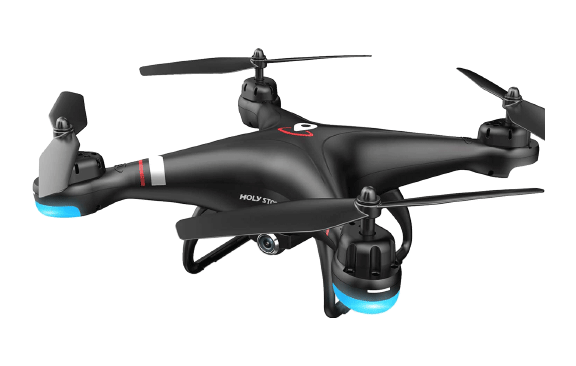
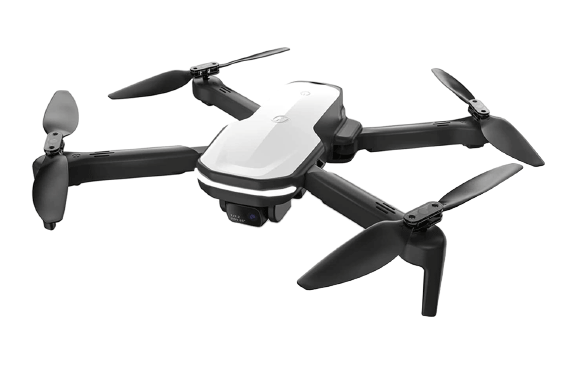
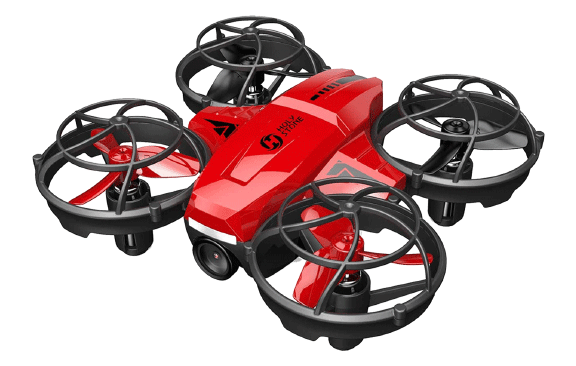
Components of a quadcopter

2023-09-05 16:24 Author:Holy Stone 0

Drone Components Explained for Beginners: A Kid-Friendly STEM Drone Guide

An easy introduction to how drones are built and how each part works.

Drones are not just fun flying toys — they are powerful STEM learning tools that combine science, technology, engineering, and mathematics. By understanding the main parts of a drone, such as the frame, motors, propellers, battery, sensors, and flight controller, kids can learn how real machines are designed and how different systems work together. This kid-friendly beginner guide explains drone skills, and a strong foundation in STEM.

What Are the Main Systems of a Drone?

Flight Control System.jpg#FlightControlSystem
Imaging System.jpg#ImagingSystem
Power System.jpg#PowerSystem
Propulsion and Airframe System.jpg#PropulsionSystem
Wireless Communication System.jpg#WirelessCommunicationSystem

Flight Control System (FCS)

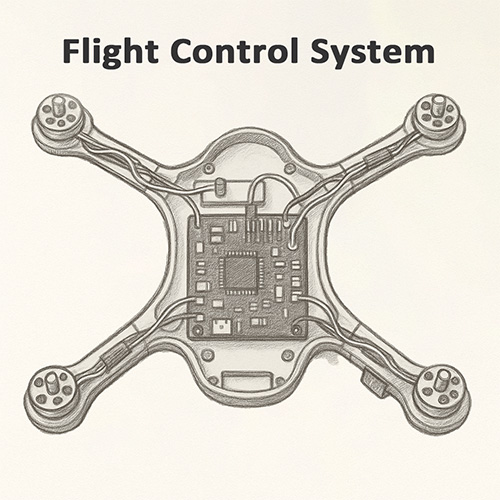
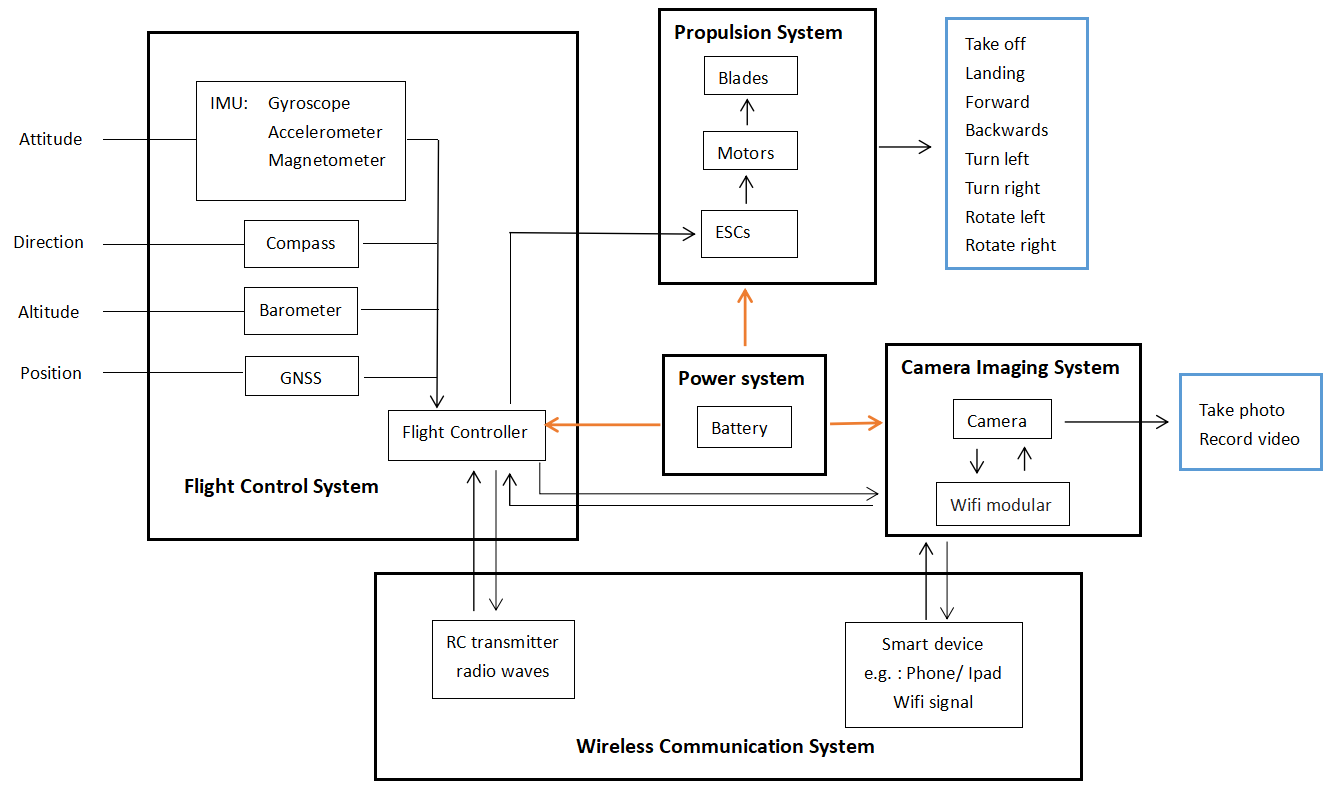
The drone’s Flight Control System (FCS) is a complete control system made up of sensors, algorithms, and control logic that work together to keep the drone stable, controllable, and safe. It processes data related to motion, orientation, magnetic direction, altitude, ground texture, and GNSS position, and uses this information to determine how the drone should behave in real time.

Flight Control System.png

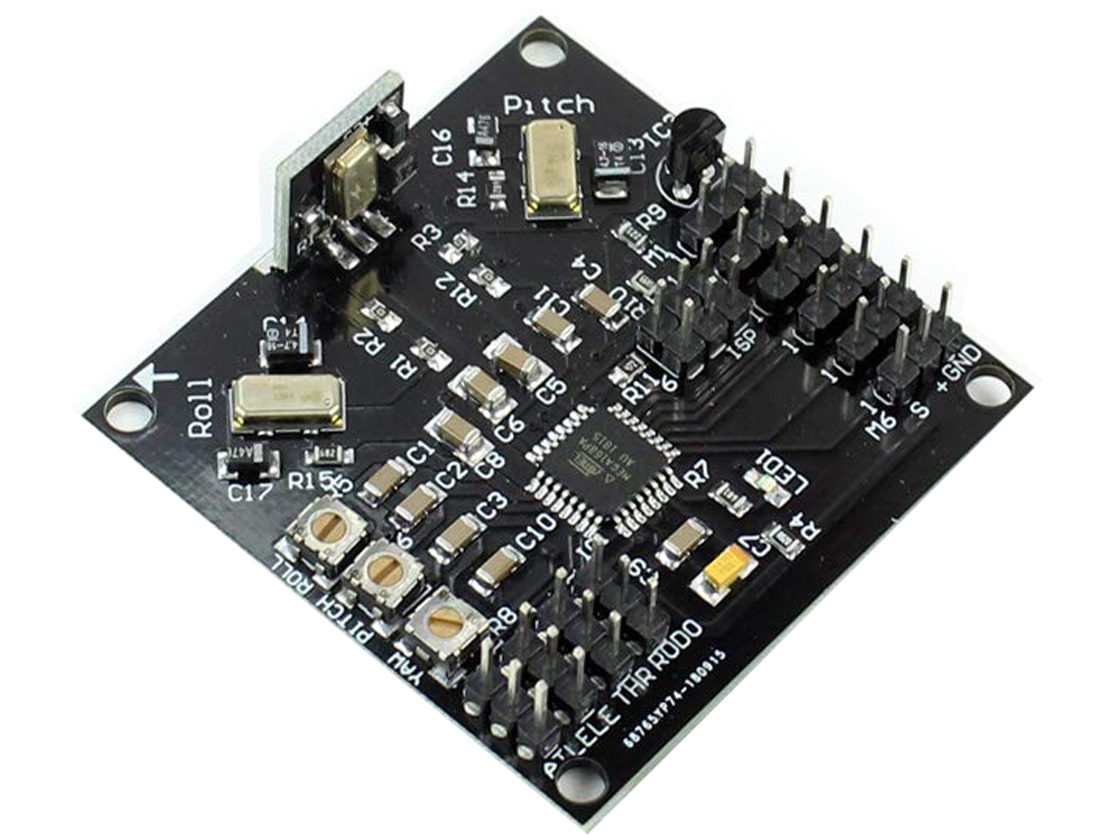
Flight Control Board

The Flight Control Board is the physical hardware that carries and runs the Flight Control System. All critical sensors are mounted on or connected to this board, and its onboard processor executes the FCS algorithms and outputs precise control signals to the motors and electronic speed controllers (ESCs).

flight controller board
In short: The Flight Control System defines how the drone thinks and flies, while the Flight Control Board is the physical platform that makes those calculations possible.

IMU Inertial Measurement Unit Attitude & Motion
Compass Magnetometer Heading Direction
Barometer Air Pressure Sensor Altitude Hold
Optical Flow Downward Camera Ground Texture Lock
GNSS GPS / Galileo / etc. Outdoor Positioning
Flight Controller Onboard “Brain” Fusion & Decision

What – What is IMU?

IMU = The drone’s balance helper

The IMU (Inertial Measurement Unit) combines gyroscopes and accelerometers to sense how the drone tilts, turns, speeds up, or slows down. It sends this data to the flight controller hundreds of times per second.

Why – Why is the IMU critical for flight stability?

The IMU (Inertial Measurement Unit) is the core sensor system that keeps a drone balanced and stable in the air.

  • Gyroscope – detects rotation and angular speed.

  • Accelerometer – measures acceleration and tilt.

  • Magnetometer – senses direction using the Earth’s magnetic field.

These sensors continuously send motion and orientation data to the flight controller, which performs high-speed calculations and constantly adjusts motor speeds in real time. This is how the drone is able to stay level, respond maintain stable flight without sudden tilting, shaking, or loss of control.

How – How does the IMU work?

When the drone moves, the IMU instantly senses every tiny change in angle, speed, and direction. It sends this information to the flight controller hundreds of times per second. The flight controller then adjusts the speed of each motor in real time to correct the drone’s position. This constant feedback and correction loop is what allows the drone to stay level, respond smoothly to control inputs, and remain stable in the air.

Extra – What is Gyroscope Calibration, and When Should You Do It?

Gyroscope calibration teaches the IMU what “perfectly level and perfectly still” looks like. During calibration, the drone records its zero-movement baseline, allowing it to correctly detect rotation, tilt, and small motion changes during flight.

You should calibrate the gyroscope when the drone shows minor tilt on takeoff, drifts without wind, or after transportation, firmware updates, or mild impact.

⚠️Do:
Place the drone on a perfectly level, stable surface and start calibration before takeoff. Calibrate after firmware updates, long storage, transportation, or when hovering becomes slightly unstable. Keep the drone completely still throughout the process.


Do Not:
Do not calibrate while holding the drone or on uneven, soft, vibrating, or windy surfaces. Do not perform calibration right after a flight while the drone is warm. Any movement during calibration may introduce errors.


Risk:
Poor gyroscope calibration may cause drifting on takeoff, unstable hovering, slow rotational drift, or inaccurate IMU readings. Proper calibration ensures stable, predictable flight.

What – What is the Compass?

Compass = The drone’s direction guide

The compass is the drone’s direction system. It tells the drone which way it is facing — front, back, left, right, and the directions of north, south, east, and west. Inside the drone, this function is handled by a tiny magnetic sensor called a magnetometer.

Why – Why does the Compass matter for flight direction?

The compass decides where the “nose” of the drone is pointing. It directly affects flight direction, hovering accuracy, and Return-to-Home safety.

  • It determines whether the drone is flying in the intended direction.

  • It ensures the Return-to-Home function brings the drone back to the correct position.

  • It helps prevent the drone from drifting in circles or getting “lost” in the air.

If the compass data is wrong, the drone may drift sideways, rotate by itself, or even try to return in the wrong direction.

How – How does the Compass work?

The magnetometer inside the drone measures the Earth’s magnetic field to determine true direction. The flight controller combines this direction data with IMU and GNSS information to calculate the drone’s heading and movement.

Before takeoff, compass calibration teaches the flight controller what the real magnetic field looks like in the current location. This is why compass calibration is a critical part of flight initialization.

If the compass is not calibrated correctly, the drone may experience circular drifting during hovering — a phenomenon known as the “Toilet Bowl Effect.”

Extra – Compass calibration and the Toilet Bowl Effect (TBE)

Compass calibration is the process of teaching the flight controller what the real Earth’s magnetic field looks like in the current environment. Because magnetic fields change from place to place, the compass needs correct calibration to give accurate heading data.

Safety tip – Where to calibrate the compass

⚠️ Do:
Calibrate the compass in a wide open outdoor area with minimal surrounding metal and electronic equipment. Choose a location with natural ground and clear space, where all potential magnetic and electromagnetic interference sources are far away.


Do Not:
Do not calibrate the compass indoors, on metal floors, on steel rooftops, next to vehicles, or near high-voltage power lines, mobile base stations, radar stations, broadcasting towers, or dense steel-reinforced buildings.


Risk:
Improper compass calibration may seriously distort heading data and trigger the Toilet Bowl Effect, leading to unstable hovering, circular drifting, and abnormal flight paths.

When should you calibrate the Compass?

  • When the drone is new or has just been repaired.

  • When flying in a new location far from the last takeoff point.

  • When the app shows a compass error or abnormal heading warning.

  • After a crash or strong impact.

What happens if the Compass is not calibrated correctly?

If calibration is skipped or performed in a magnetically polluted area, the flight controller may receive incorrect heading data. This can lead to side drifting, unexpected rotation, inaccurate Return-to-Home direction, or a typical hovering instability called the “Toilet Bowl Effect” (TBE).

What is the Toilet Bowl Effect (TBE)?

The Toilet Bowl Effect describes a situation where a drone, instead of hovering steadily, starts to fly in widening circles around a point — similar to water swirling in a toilet bowl.

Typical flight behavior

  • The drone slowly rotates by itself.

  • At the same time, it drifts sideways.

  • The circular path becomes larger and larger.

What is happening inside the flight controller?

From a flight control perspective, the Toilet Bowl Effect appears when the three core direction systems do not agree with each other:

Compass heading ≠ GNSS motion direction ≠ IMU attitude calculation

The flight controller keeps correcting a drift that does not truly exist. Each wrong correction creates a new error, causing the spiral movement to grow larger and larger over time.

What causes the Toilet Bowl Effect?

  • Incorrect compass calibration near steel structures, cars, manhole covers, or strong magnetic sources.

  • Powering on indoors without GPS and then switching to GPS mode outdoors in mid-air.

  • Magnetic interference from motor current, wiring, or a battery placed too close to the magnetometer.

  • Physical damage or aging of the compass hardware after crashes or water exposure.

What should pilots do?

If early signs of the Toilet Bowl Effect appear, pilots should:

  • Land immediately.

  • Recalibrate the compass in a clean, open outdoor environment.

  • Check for magnetic interference before continuing the flight.

What – What is the Barometer?

Barometer = The drone’s height sensor

The barometer is the sensor that tells the drone how high it is flying. It does this by measuring changes in air pressure and converting them into altitude information.

Why – Why is the Barometer important for stable altitude?

The barometer allows the drone to hold a steady height in the air instead of rising or falling unexpectedly. This is especially important for indoor flight and beginner-friendly hovering.

  • It keeps the drone from suddenly shooting upward.

  • It prevents sudden drops during hovering.

  • It makes takeoff and landing smooth and controlled.

Without a working barometer, the drone would struggle to maintain a stable height, making flight unsafe and difficult to control.

How – How does the Barometer work?

When the drone takes off, the barometer records the air pressure at ground level as a reference point. As the drone climbs higher, the air pressure becomes lower. The flight controller constantly compares these pressure changes to calculate the drone’s altitude.

If the drone starts to rise or sink unintentionally, the flight controller immediately adjusts motor speed to bring it back to the selected height. This continuous feedback loop is what gives the drone its stable altitude hold.

Extra – When can the Barometer become inaccurate?

In some everyday situations, the air pressure around the drone can change suddenly or become very uneven. This can confuse the barometer and make the reported height less accurate.

  • Near air-conditioner outlets where strong airflow disturbs pressure.

  • Directly in front of an electric fan blowing at the drone.

  • In small enclosed rooms where opening or closing a door changes pressure instantly.

  • During very fast climbs or drops, where pressure response may lag behind.

  • When there is a sudden temperature change affecting air density.

Safety tip – Barometer disturbance from strong airflow

⚠️ Strong airflow from air conditioners, electric fans, or sudden door openings can disturb the barometer and cause unstable altitude during hovering or landing.

In these conditions, the drone may show unstable altitude readings, small up-and-down hovering movements, or incorrect height during automatic landing.

What – What is Optical Flow?

Optical Flow = The drone’s near-ground visual positioning sensor

Optical Flow is a visual sensor system that uses a small downward-facing camera to observe how ground textures move beneath the drone. By analyzing these visual changes frame by frame, it can detect whether the drone is drifting left, right, forward, or backward.

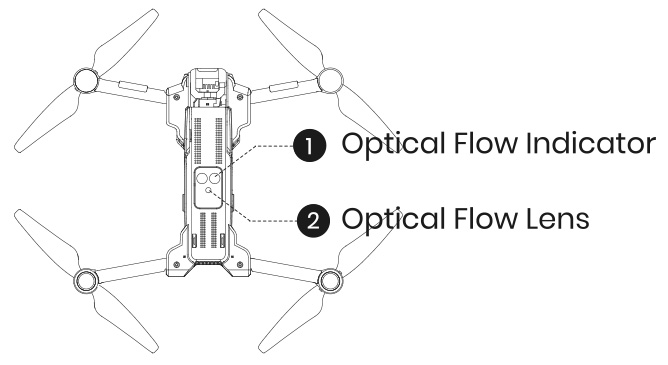
The physical location of the Optical Flow module can be seen in the image on the right. While it belongs to the Flight Control System, the Optical Flow sensor is built as an independent hardware module, installed separately from the main flight control board and linked through signal connections.

Optical Flow Lens.jpg

Why – Why is Optical Flow important for low-altitude stability?

Optical Flow plays a key role in stabilizing the drone during low-altitude and near-ground flight, especially when GPS positioning is weak or unavailable (for example, indoors or close to buildings and trees).

  • It prevents slow horizontal drifting during hovering.

  • It improves stability during indoor and low-altitude outdoor flight.

  • It helps beginners keep the drone steady without constant stick correction.

Without Optical Flow, a drone flying close to the ground would be much more likely to slide across the floor or wander unpredictably due to small air movements or control delay.

How – How does Optical Flow work?

The downward camera continuously captures images of the surface beneath the drone. The system compares how the position of ground features changes from one frame to the next to calculate horizontal motion.

If the drone begins to drift unintentionally, the Optical Flow data is sent to the flight controller, which then adjusts motor output in the opposite direction to lock the drone’s position and maintain stable hovering near the ground.

Optical Flow Positioning is typically used in indoor environments or low-altitude outdoor flight when GPS signals are weak or unavailable. The recommended working height for Optical Flow Mode is approximately 1.6–9.8 ft. In darker environments, you can turn on the lights by pressing the light button on the transmitter to help the camera recognize the ground texture.

Safety tip – When Optical Flow may not work

⚠️ Environment:
Avoid flying over featureless, monochrome, repetitive, highly reflective, transparent, water, or moving surfaces. Avoid extremely dark, overly bright, or rapidly changing lighting. Do not fly at excessive low-altitude speed.

Maintenance:
Keep the Optical Flow sensor clean at all times. Do not scratch or tamper with it. Avoid dusty and humid environments.

Fail-Safe Behavior:
If Optical Flow visual data becomes unavailable, the drone will revert to basic altitude-hold mode only. Always fly with extra caution when operating close to the ground.

What – What is GNSS?

GNSS = The drone’s satellite positioning system

GNSS (Global Navigation Satellite System) is the satellite-based positioning system that tells the drone where it is on the Earth. By receiving signals from multiple satellites in space, the drone can calculate:

  • Its exact location.

  • Its direction of movement.

  • Whether it can safely Return-to-Home.

Safety tip – GNSS lock before takeoff

⚠️ Always wait until at least 7 or more satellites are locked before takeoff.

Taking off without a solid GNSS lock may cause drifting, inaccurate Return-to-Home, or unstable positioning.

Safety tip – Environments where GNSS is unreliable

⚠️ GNSS may be unreliable or unavailable indoors, under trees, near power towers, between tall buildings, or underground.

Do not rely on GPS positioning in these environments.

Common GNSS satellite systems used by drones

SystemCountry / RegionDescription
GPSUnited StatesMost widely used global system
GLONASSRussiaImproves positioning stability
GalileoEuropean UnionVery high positioning accuracy
BeiDouChinaStrong global and regional coverage
QZSSJapanRegional signal enhancement system

Multi-GNSS positioning

Many modern drones use multi-GNSS positioning, such as GPS + Galileo + BeiDou working together at the same time.

  • Faster satellite lock.

  • More stable signals.

  • Stronger resistance to signal blockage.

  • More accurate Return-to-Home.

Why – Why is GNSS essential for outdoor safety and navigation?

GNSS is the main system that allows a drone to “know where it is” outdoors. It is the foundation for safe, easy-to-use GPS flight modes.

  • It enables precise position hold in outdoor environments.

  • It supports accurate Return-to-Home when the pilot presses the button or the signal is lost.

  • It allows pre-planned routes, waypoint flights, and intelligent flight modes based on map location.

Without reliable GNSS, the drone would drift with the wind outdoors and could not safely return to its takeoff point if the pilot loses orientation or signal.

How – How does GNSS work?

The GNSS receiver on the drone listens to signals from multiple satellites in the sky. By measuring how long each signal takes to arrive, it calculates the distance to each satellite and uses triangulation to determine the drone’s position and ground speed.

The flight controller then fuses this satellite data with information from the IMU and compass to keep the drone locked to a point in space or follow a path on the map. For GNSS to work well, the drone needs an open sky view, enough visible satellites, and a stable “GPS lock” before takeoff.

Extra – When can GNSS become unreliable or fail?

Safety tip – What affects GNSS accuracy

⚠️ Do:
Fly in wide, open outdoor environments where the drone has a clear view of the sky.GNSS works best when satellite signals are unobstructed, free from reflections, and not affected by electromagnetic interference. Before takeoff, wait until satellite searching is complete and the app shows “GPS Ready” / “GPS Locked”.


Do Not:
Do not take off indoors, in underground or semi-enclosed areas, under roofs,inside tree canopies, or inside narrow valleys where satellites are blocked. Avoid flying close to large reflective surfaces such as glass curtain walls, metal roofs, smooth concrete, water surfaces, or clusters of parked vehicles, which may cause multipath reflections. Stay away from high-voltage power lines, mobile base stations, radar stations, and broadcasting towers that may introduce electromagnetic interference.Do not power on the drone indoors and then switch to GPS mode outdoors in mid-air, as this may lead to heading errors and unstable hovering.


Risk:
Poor GNSS conditions may cause drifting, inaccurate Home Point, delayed GNSS lock, unstable hovering, circular drifting (Toilet Bowl Effect), or incorrect Return-to-Home behavior. Always ensure strong and stable GNSS reception before takeoff.

When GNSS conditions are unstable, pilots should avoid relying solely on GPS mode. Keep the drone low and close, or wait until satellite reception becomes stable again before continuing flight.

What – What is the Flight Controller?

Flight Controller = The drone’s flying brain

The flight controller is the onboard computer at the center of the drone. It listens to all the sensors, reads the pilot’s commands from the remote controller or app, and decides how fast each motor should spin to keep the drone flying safely and smoothly.

Why – Why is the Flight Controller so important?

Without the flight controller, all the sensors and motors would just be separate parts. The flight controller turns them into a coordinated flying robot.

  • It fuses data from the IMU, Compass, Barometer, Optical Flow, and GNSS into one “big picture” of where the drone is and how it is moving.

  • It translates the pilot’s stick movements and app commands into safe, smooth motions instead of sudden or unstable jumps.

  • It manages safety features such as Return-to-Home, low-battery protection, and loss-of-signal failsafes.

In short, the flight controller is the reason a modern drone can feel easy and predictable to fly, even for beginners.

How – How does the Flight Controller work?

Inside the flight controller, control algorithms run in a fast loop many times per second. Each loop can be thought of as three simple steps:

  • 1. Read – Collects fresh data from the sensors and reads the pilot’s latest commands.

  • 2. Think – Calculates how much the drone should tilt, climb, turn, or brake to stay stable and follow the commanded path.

  • 3. Act – Sends precise speed changes to each motor (and sometimes to the gimbal) to make the correction happen.

Because this loop runs hundreds of times per second, the flight controller can react to wind gusts, sudden stick inputs, and small disturbances long before most pilots would notice them with their eyes.

Extra – How can pilots help the Flight Controller?

Even the smartest flight controller needs a little help from the pilot to do its job well. Good habits before and during flight make its work much easier.

  • Perform basic checks: propellers tight, battery locked, and sensors or camera lenses clean.

  • Complete required calibrations (IMU, compass, etc.) in a suitable environment when the app asks for them.

  • Wait for a stable GNSS lock and enough satellites before taking off outdoors.

  • Avoid flying in places with strong magnetic or radio interference that can confuse the sensors.

When pilots follow these steps, the flight controller can fully use all six key modules to keep every flight safer and more enjoyable.

Imaging System (Camera & Video System)

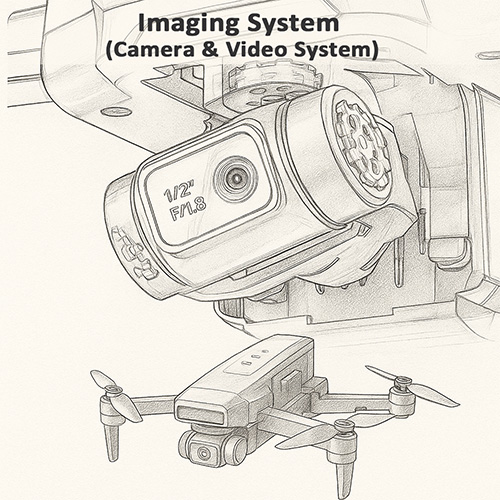
The drone’s Imaging System is the part that decides what you actually see in your photos and videos. It is made up of the camera sensor, lens and field of view (FOV), image stabilization system (EIS or gimbal), image processor (ISP), video resolution and frame rate settings, and the FPV live video transmission link.

Camera Sensor Image Sensor Light Capture
Lens & FOV Lens Design Viewing Angle
Stabilization EIS / Gimbal Smooth Footage
Image Processor ISP Chip Color & Detail
Resolution & FPS 4K / 2.7K / 1080p 24 / 30 / 60fps
FPV Transmission Live View Latency & Range

What – What is the Camera Sensor?

Camera Sensor = The drone’s electronic eye

The camera sensor is the heart of the imaging system. It is a small electronic chip (usually a CMOS sensor) that turns incoming light into electrical signals and then into digital image data. Its size, design, and quality largely determine how clear, clean, and detailed your photos and videos will be.

In practice, when people talk about “how good the sensor is”, they are usually talking about five core, easy-to-understand aspects:

  • 1. CMOS technology – the manufacturing process of the sensor. Modern CMOS sensors are more sensitive, use less power, and read out image data faster, which helps with low light and high-frame-rate video.

  • 2. Pixel count (megapixels) – how many tiny light-sensing cells (pixels) the sensor has, for example 12MP, 20MP, or 48MP. More pixels allow higher resolution images, but only work well when combined with a good sensor size and design.

  • 3. Sensor size – the physical area of the sensor, often written as 1/2.3", 1/2", 1", etc. A larger sensor can collect more light per frame, which improves detail, dynamic range, and low-light performance.

  • 4. Pixel / circuit design – how each pixel and the surrounding circuitry are laid out on the chip (for example front-illuminated vs back-illuminated, stacked structure, etc.). Better designs allow each pixel to “catch” more light and reduce noise and artifacts.

  • 5. Output capability – what the sensor + image pipeline can actually deliver: maximum photo resolution, video formats (such as 4K / 2.7K / 1080p), supported frame rates, and how clean and natural the final image looks.

Together, these five factors decide how much light the sensor can capture and how good the final image quality can be, far beyond just a single “MP” number on the spec sheet.

Why – Why experienced pilots care more about the sensor than the “megapixel number”

In the aerial photography community, any pilot with a bit of experience knows that the “4K” and “48MP” numbers in ads are only surface specs. The real limit of image quality is set by the sensor size, pixel structure, and underlying light-gathering ability, not by the megapixel label alone.

  • A larger sensor collects more light. This means cleaner shadows, better detail, and wider dynamic range, especially in complex lighting.

  • Cramming too many pixels into a very small sensor (common on 1/5'' or 1/6'' “toy-grade” sensors) makes each pixel extremely tiny. Low-light noise goes up, fine detail gets smeared, and night scenes often look worse, not better.

  • This is why two drones that both say “4K” on the box can sit in completely different image-quality leagues once you actually fly and compare the footage.

  • In the $50–$120 price band, it is almost impossible to find a true native 4K sensor. Around 90% of the “high-resolution” claims are really a mix of software upscaling, ultra-small CMOS sensors, and heavy algorithmic sharpening. The image is largely “built” by software instead of captured by strong hardware.

  • At higher price levels, sensor size and pixel design usually become more reasonable. Only then do you start to see cameras that can genuinely deliver the 4K performance their spec sheet promises.

For experienced pilots, a well-tuned 12MP or 20MP sensor with a decent-sized “bottom” is often far more valuable than a hyped “48MP” sensor that relies on pixel stuffing and interpolation.

In short, megapixels are just the result number. The sensor is the physical foundation that decides whether your drone can actually capture beautiful, clean footage in the real world.

How – How does the camera sensor work inside a drone?

During flight, light from the scene passes through the lens and falls onto the camera sensor. Each tiny pixel on the sensor measures how much light it receives and converts this into an electrical signal. The image processor then reads this data line by line to build a full-resolution image or video frame.

This process repeats many times per second. For example, when recording 4K 30fps, the sensor is creating and sending 30 full 4K frames every second to the image processor.

Extra – Common myths about drone camera sensors

  • Myth 1: “More megapixels always means better image quality.” Reality: On small drone sensors, overly high pixel counts can reduce sensitivity and increase noise.

  • Myth 2: “Two drones with 4K sensors must have similar image quality.” Reality: Sensor size, pixel design, and image processing make a huge difference between brands and models.

  • Myth 3: “Daylight shots look fine, so the sensor must be great.” Reality: A strong sensor really proves itself in high-contrast scenes (bright sky + dark trees) and at sunset or night.

What – What is Field of View (FOV)?

FOV = How wide the drone camera can see

Field of View (FOV) describes how wide the camera can see and is measured in degrees. A larger FOV means the camera captures more of the scene in a single frame; a smaller FOV shows a tighter, more focused view.

FOV directly influences how the image looks in terms of width, distortion, perspective, and immersion. It is one of the most important lens parameters shaping the style of your footage.

In the drone world, it is important to separate two very different design goals:

  • Aerial camera drones – aim for natural, low-distortion footage for travel, landscape, and city shots. Most consumer aerial drones use a moderate FOV that feels close to human vision.

  • FPV / racing drones – use ultra-wide, more distorted FOV to maximise immersion, speed feeling, and awareness of obstacles during high-speed flying.

The same “FOV” term can therefore describe very different experiences depending on whether the drone is built for cinematic aerial imaging or FPV-style flying.

Why – Why does FOV matter when choosing a drone?

FOV directly defines how your footage feels: whether it looks natural and comfortable to watch, or extreme and immersive like an action camera or FPV feed.

  • Standard aerial FOV (around 80°–90°) is the “sweet spot” for everyday aerial footage. It keeps buildings straight, horizons level, and provides a wide but not exaggerated perspective. Many popular camera drones from major brands sit roughly in this range.

  • Narrower FOV (often used on some higher-end, cinema-style lenses) gives straighter lines, stronger subject separation, and a more “compressed”, film-like perspective. It is great for architecture and storytelling shots but less forgiving for beginners.

  • Ultra-wide FOV (typical on FPV and racing drones) delivers a dramatic sense of speed and immersion and shows a very large portion of the surroundings – but with clear “fisheye” distortion, especially at the edges.

This is why experienced pilots do not look at resolution alone. The same 4K resolution with a different FOV can produce footage that feels like a cinematic movie, a natural travel vlog, or a wild FPV ride.

How – How to choose the right FOV for your flying style

1. If you mainly want travel and landscape footage

  • Look for an aerial camera drone with a moderate FOV around 80°–90°. This is the standard range for natural, low-distortion aerial images that are easy to watch and easy to edit.

  • Many consumer drones from leading brands choose an effective FOV in the low 80s, which balances wide coverage with controlled distortion.

2. If you want professional, “cinematic” framing

  • Some high-end camera drones use a slightly narrower FOV than mainstream models. This reduces distortion, keeps architectural lines very straight, and creates a more film-like, compressed perspective.

  • This look can be fantastic for city skylines and controlled storytelling shots, but it requires more careful planning of flight paths and composition.

3. If you are interested in FPV-style flying

  • FPV and racing drones often use very wide FOV to maximise peripheral vision and safety when flying fast and close to obstacles. This is normal and desirable for FPV, even though the footage looks noticeably distorted compared to standard aerial shots.

  • Some cine-FPV setups may choose a slightly less extreme wide angle to keep the immersive feel while making the distortion more controllable in post-production.

In short, there is no “best” FOV for all drones. The right choice depends on whether you want natural aerial images, cinematic compression, or FPV-style immersion.

Extra – Practical FOV tips when comparing drone cameras

  • For most new pilots and travel users – an aerial camera drone with a moderate FOV (around 80°–90°) will give the most natural result: wide enough for landscapes, but without heavy distortion.

  • If a non-FPV camera drone advertises extremely wide FOV (similar to an action camera), be cautious. The footage may rely heavily on software distortion correction or produce stretched edges that do not look like classic aerial photography.

  • For FPV-style flying, a very wide FOV is a feature, not a bug. It helps pilots see more of the environment and judge speed and distance better, even though the image is visibly curved at the edges.

  • Always check sample videos. FOV is not a “bigger is better” parameter – it is about whether the perspective matches the kind of footage you actually want to create.

Remember: FOV defines the style of your image. Resolution and sensor quality decide how sharp and clean it looks, but FOV decides whether it feels like a natural aerial shot, a cinematic frame, or an FPV ride.

What – What is image stabilization (EIS and gimbal)?

Stabilization = How to keep video smooth when the drone is moving

Image stabilization is the system that reduces shake and vibration in your footage. Drone cameras typically use two main methods:

  • EIS (Electronic Image Stabilization) – uses software to crop and re-align each frame.

  • Mechanical gimbal – uses motors to physically keep the camera level and stable.

Why – Why do smooth videos depend so much on stabilization?

Even on a calm day, a drone is constantly correcting its position in the air. Tiny angle changes that you barely notice with your eyes can turn into very visible shaking in the footage if there is no stabilization.

  • Stabilization makes slow cinematic shots look buttery smooth instead of jittery.

  • It helps the camera handle wind gusts and quick turns without ruining the video.

  • It is especially important when recording at 4K resolution, where every small movement is more visible.

How – How do EIS and gimbal work differently?

EIS works by recording a slightly larger image on the sensor, then cropping and shifting the frame digitally to counteract motion. It is lightweight and cheap, but it can:

  • Reduce the effective FOV (the shot becomes a bit tighter).

  • Sometimes create “jelly” or warping artifacts in extremely shaky scenes.

A mechanical gimbal uses tiny motors to physically rotate the camera in the opposite direction of the drone’s movement. The flight controller and gimbal controller work together to keep the horizon level.

  • Provides much smoother, more natural motion.

  • Maintains full sensor area and FOV.

  • Allows precise tilt control for framing while flying.

Extra – Which stabilization type is better for you?

For casual flying and basic social-media clips, a good EIS system can already deliver acceptable results. For more serious aerial photography or future-proof footage, a 3-axis gimbal offers a big step up in quality and is worth prioritizing when choosing a drone.

What – What is the Image Processor (ISP)?

Image Processor = The “photo lab” inside your drone

The Image Signal Processor (ISP) is a dedicated chip that takes raw data from the sensor and turns it into a finished photo or video frame. It controls exposure, white balance, color tone, sharpness, noise reduction, and many other steps that shape the final look.

Why – Why can two “4K cameras” look so different?

Even if two drones use similar sensors and resolutions, their videos can look very different because of ISP tuning.

  • Aggressive noise reduction can make images look soft and smeared, especially in grass or leaves.

  • Over-sharpening can create unnatural halos around edges.

  • Poor color tuning can cause skin tones to look gray or overly red, and skies to look dull or unnatural.

A well-designed ISP keeps a good balance: clean noise control, natural colors, and enough fine detail without looking harsh.

How – What does the ISP do to every frame?

For every photo or video frame, the ISP typically runs through a pipeline like this:

  • 1. Demosaicing – reconstructs full-color pixels from the raw sensor pattern.

  • 2. Exposure & tone mapping – balances bright highlights and dark shadows.

  • 3. White balance – makes whites look neutral under different lighting.

  • 4. Noise reduction – cleans up grain, especially in low light.

  • 5. Sharpening & detail enhancement – brings back clarity without over-processing.

  • 6. Color style – applies the brand’s picture profile or “look”.

All these steps happen in milliseconds for every frame while you are flying.

What – What are resolution and frame rate?

Resolution & FPS = How sharp and how smooth your videos look

Resolution (such as 4K, 2.7K, or 1080p) describes how many pixels each frame contains. Frame rate (such as 24, 30, or 60fps) describes how many frames are captured per second.

Why – How do resolution and FPS affect real footage?

  • Higher resolution (like 4K) captures more fine detail and looks sharper on big screens.

  • Higher frame rate (like 60fps) makes motion smoother and allows light slow-motion in editing.

  • But higher resolution and frame rate also mean larger file sizes and higher demands on the sensor, processor, and memory card.

For cinematic travel videos, many pilots choose 4K 30fps. For action shots or fast sports, 1080p or 2.7K at 60fps can be a good balance between smoothness and storage.

How – What should beginners pay attention to?

  • Check whether the drone’s “4K” is true sensor 4K or up-scaled from a lower resolution.

  • Make sure your microSD card meets the required speed class; otherwise recording may stop or drop frames.

  • For low-light flights, consider using a slightly lower frame rate (such as 24 or 30fps) so the sensor has more time to collect light per frame.

Safety tip – microSD card speed requirement

⚠️ Using a microSD card that does not meet the required speed class may cause dropped frames, recording errors, or interrupted video files.

What – What is FPV live video transmission?

FPV Transmission = The live link between the drone and your screen

FPV (First-Person View) transmission is the wireless system that sends a live video feed from the drone’s camera to your smartphone or remote controller screen while you fly.

Why – Why are latency and signal quality so important?

A clear and responsive live view is essential for safe and enjoyable flights.

  • Low latency means the image on your screen closely matches the drone’s real-time position.

  • Stable signal helps avoid image freezes or heavy blocky artifacts when the drone is far away.

  • FPV quality is especially important when flying near obstacles or when framing precise shots.

How – How does FPV transmission work on a drone?

The drone compresses the camera signal into a live video stream and sends it over a wireless link, usually using 2.4GHz or 5GHz frequencies. The receiver in the remote controller or phone decodes this stream and shows it as the FPV image.

More advanced digital systems use techniques such as channel hopping, forward-error correction, and smart bitrate control to keep the video stable over longer distances.

For best results, pilots should:

  • Fly with the antennas oriented correctly as described in the manual.

  • Avoid flying behind large buildings, trees, or metal structures that block the signal.

  • Keep away from strong Wi-Fi interference when possible, especially in crowded city areas.

Power System (Battery & Power Delivery)

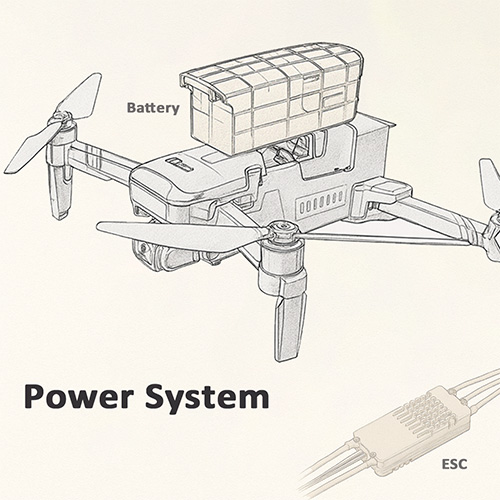
The drone’s Power System is the part that stores, delivers, and manages electrical energy. It includes the battery pack, electronic speed controllers (ESCs), power distribution wiring, connectors and cables, and the monitoring and protection circuits that keep everything safe. Together, these components decide how long the drone can fly and how reliably the motors receive clean power.

Battery Pack Main Power Source Voltage & Capacity
ESC Electronic Speed Controller Motor Power Control
Power Distribution Power Lines & Boards Feeds All Systems
Connectors & Cables Plugs & Wires Current Path
Power Monitoring Voltage & Current Smart Warnings
Charging & Safety Safe Charging Battery Care

What – What is the battery pack?

Battery Pack = The drone’s fuel tank made of electricity

The battery pack is a rechargeable Li-ion or Li-Po battery that stores energy for the entire drone. It provides a certain voltage (for example 7.4V, 11.1V) and a capacity (for example 2,000mAh or 3,000mAh), which together decide how powerful and how long the drone can fly.

Why – Why is the battery the core of the power system?

  • The voltage must match the motors and ESCs; too low and the drone is weak, too high and parts can be damaged.

  • The capacity and battery health directly affect flight time.

  • The battery’s discharge ability (how much current it can safely deliver) lets the drone handle fast climbs and sudden braking.

A healthy, well-designed battery gives stable voltage from takeoff to landing, which keeps the drone responsive and safe in the air.

How – How does the battery work during a flight?

When you arm the motors and take off, the battery starts delivering current through the power wires to the ESCs, flight controller, camera, and other modules. As the pilot pushes the sticks harder, the motors draw more current and the battery voltage slowly drops.

The power system and flight controller monitor this voltage. When it falls below certain levels, the drone will show low-battery warnings, slow down, or automatically start a Return-to-Home procedure to avoid a sudden power loss in mid-air.

What – What is an ESC (Electronic Speed Controller)?

ESC = The power translator between the battery and the motors

An ESC takes commands from the flight controller and turns them into precise high-frequency power signals for each motor. In brushless drones, every motor usually has its own ESC channel.

Why – Why are ESCs so important for smooth control?

  • They decide how fast each motor spins, which directly controls climb, descent, turning, and braking.

  • Good ESCs react very quickly, helping the flight controller correct tiny attitude errors in milliseconds.

  • They also include protection functions such as over-current, over-temperature, and short-circuit protection.

How – How does an ESC work in each control loop?

In each control cycle, the flight controller sends a speed command to the ESC (for example “Motor 1: 65% power”). The ESC then switches the battery voltage on and off very quickly in special patterns to drive the brushless motor coils. This method is called PWM or FOC control.

By adjusting the duty cycle and timing of these pulses, the ESC can accelerate or slow the motor very smoothly, which is essential for stable, quiet, and efficient flight.

What – What is power distribution?

Power Distribution = The “electrical roads” inside the drone

Power distribution is the network of boards and thick copper wires that carry battery power to each ESC, motor, and low-voltage module. Many drones use a Power Distribution Board (PDB) or a combined flight-controller-plus-PDB board.

Why – Why does clean power distribution matter?

  • Proper wire thickness prevents overheating during high-current climbs.

  • Good layout reduces electrical noise that could disturb the GNSS, compass, or FPV signal.

  • Built-in voltage regulators can provide stable 5V or 12V for cameras, receivers, and LEDs.

How – How does power flow through the drone?

From the battery connector, power first enters the power distribution board. Thick traces or wires branch out to each ESC and motor. At the same time, smaller regulators step the voltage down to levels suitable for the flight controller, camera, gimbal, and other electronics.

This layout makes sure that even during full-throttle maneuvers, every part of the drone still receives enough voltage to keep working correctly.

What – What are power connectors and cables?

Connectors & Cables = The plugs and paths that carry current

Connectors are the plastic-and-metal plugs that let you easily attach and remove the battery or modules. Power cables are the insulated copper wires that link everything together.

Why – Why do small connectors matter so much?

  • A loose or damaged connector can instantly cut power and cause a crash.

  • Undersized cables can get hot and waste energy as heat.

  • Good contact surfaces reduce voltage drop, helping motors produce full thrust.

How – How should pilots care for connectors and cables?

Before flight, pilots should check that the battery plug clicks firmly into place and that no cable insulation is broken or pinched between parts of the frame. After many flights, slightly dark or loose connector pins can be cleaned or replaced to keep the power path healthy.

What – What is power monitoring?

Power Monitoring = The “battery health meter” for the drone

Power monitoring circuits measure battery voltage, current draw, and sometimes remaining capacity. Smart batteries may include a tiny Battery Management System (BMS) chip that tracks charge cycles and cell balance.

Why – Why are smart warnings so important for safety?

  • They help prevent over-discharge, which can permanently damage Li-Po cells.

  • They allow the drone to trigger low-battery Return-to-Home before power runs out.

  • They give pilots a clear idea of real-world flight time under different flying styles.

How – How does the drone use power monitoring data?

During flight, the monitoring chip sends live voltage and current information to the flight controller and app. Based on preset thresholds, the system can pop up warnings, limit maximum thrust, or automatically start landing or returning home.

This gives pilots a safety cushion instead of guessing how much power is left.

What – What is the charging and safety system?

Charging & Safety = How to refill and protect the battery

The charging system includes the dedicated charger, balancing circuits, and safety rules that keep the battery in a healthy range during everyday use.

Why – Why do correct charging habits matter?

  • Proper charging helps the battery keep its capacity and power for many cycles.

  • Safety features reduce the risk of over-charging, swelling, or fire.

  • Good storage habits (for example partial charge before long-term storage) extend battery life.

How – How should beginners charge and store drone batteries?

Beginners should always use the original charger, place the battery on a non-flammable surface, and keep it away from flammable materials while charging. After flying, very hot batteries should cool down before being recharged.

For long-term storage, many smart chargers and batteries support a “storage level” mode that leaves the battery around 40–60% charged, which is much kinder to Li-ion and Li-Po cells than keeping them full or completely empty.

Propulsion & Airframe System (Thrust & Structure System)

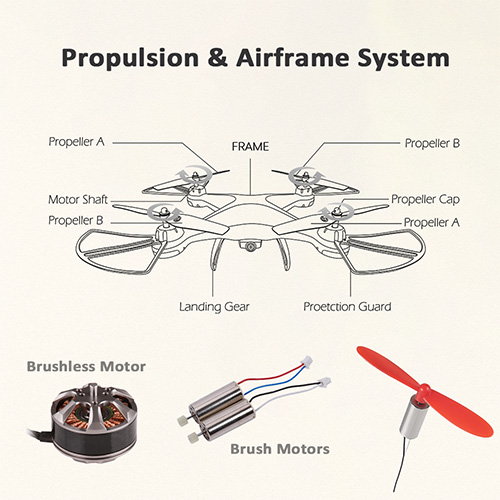
The drone’s Propulsion & Airframe System is the part that turns electrical power into thrust and safely carries all the hardware in the air. It includes the motors that generate thrust, the propellers that turn rotation into lift, the frame and arms that hold everything in place, and the landing gear that supports takeoff and landing. Together, these parts decide how strong the thrust is, how agile the drone feels, and how well it survives everyday bumps and landings.

Motors Generate Thrust Brushless / Brushed
Propellers Convert Rotation to Lift Pitch & Diameter
Frame & Arms Hold Motors & Props Layout & Rigidity
Landing Gear Takeoff / Landing Protect Body & Camera

What – What are the motors?

Motors = The thrust engines of the drone

The motors turn electrical power into spinning force. On most camera drones they are brushless DC motors, which are efficient, powerful, and long-lasting. Each motor is paired with a propeller and controlled by an ESC to produce exactly the amount of thrust the flight controller needs.

Why – Why are motors so important?

  • Motor quality directly affects how much weight the drone can lift and how stable it feels in the air.

  • Matched motors keep the drone balanced; a weak or damaged motor can pull the drone to one side.

  • Efficient motors use less battery, extending flight time.

How – How do motors work during flight?

During flight, the flight controller constantly adjusts each motor’s speed through the ESCs. Small speed changes on different corners of the drone create roll, pitch, and yaw motions. When all motors speed up together, the drone climbs; when they all slow down, the drone descends.

What – What are the propellers?

Propellers = The wings that turn rotation into lift

Propellers are carefully shaped blades that push air downwards when they spin, creating upward lift. Their diameter and pitch decide how much air they move and how quickly they can react to control changes.

Why – Why do propeller size and shape matter?

  • Larger or higher-pitch props can produce more thrust but may respond slower and draw more power.

  • Balanced propellers reduce vibration, which helps the camera and sensors work better.

  • Using the correct propeller direction (CW / CCW) prevents the drone from spinning uncontrollably.

How – How should pilots care for propellers?

Pilots should check for cracks, chips, or bends before each flight. Damaged propellers should be replaced immediately. It is also important to lock props firmly in place and to use only the models recommended for the drone, so the motors and ESCs are not overloaded.

What – What are the frame & arms?

Frame & Arms = The skeleton that holds everything together

The frame is the central body of the drone, and the arms extend outward to hold the motors and propellers. They set the drone’s shape (for example X-type quadcopter) and keep components aligned so that all forces balance correctly in flight.

Why – Why are frame stiffness and layout important?

  • A stiff frame reduces flexing, which keeps the drone’s sensors and camera stable.

  • The arm length and angle decide how far the propellers are from each other, affecting stability and agility.

  • Good layout makes it easier to route cables safely and cool the electronics.

How – How does the frame protect and support the drone?

The frame provides mounting points for the flight controller, GPS, camera, battery, and other modules. It also absorbs part of the energy during minor bumps or hard landings, helping to protect delicate electronics and keep the drone flying true over many flights.

What – What is the landing gear?

Landing Gear = The feet of the drone

The landing gear is the structure that touches the ground when the drone takes off and lands. It can be fixed legs, folding feet, or extended skids, and is often designed to keep the propellers and camera away from dust, grass, and small stones.

Why – Why does landing gear design matter?

  • Good landing gear spreads impact forces and reduces the chance of tipping over.

  • Enough height keeps the camera and gimbal from hitting the ground.

  • Wide stance legs improve stability on uneven surfaces.

How – How should pilots use and protect the landing gear?

Pilots should choose flat, clear areas for takeoff and landing whenever possible, and avoid rocks, tall grass, or puddles. After a hard landing, it is worth checking the legs for cracks or bending, because damaged landing gear can affect the drone’s balance or scratch the camera on the next flight.

Wireless Communication System

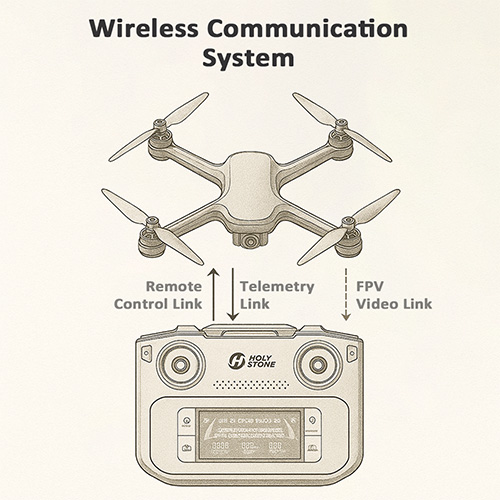
The Wireless Communication System is the invisible bridge between your drone and remote controller. It carries your stick and button commands up to the drone, and sends live video plus status data back down to your screen. In a typical consumer drone, this system is built from three data links (control, FPV video, telemetry) working on specific frequency bands and channels, using dedicated antennas. On top of these links, fail-safe rules decide what the drone does when the signal becomes too weak or is completely lost – they are rules based on the existing links, not a new, separate radio path.

Remote Control Link Stick & Button Commands From Your Hands to the Drone
FPV Video Link Live Camera View From Drone to Screen
Frequency & Channels 2.4GHz / 5GHz Bands Hardware Limits & Channels
Antenna System Mouth & Ears of the Link Coverage, Direction & Range
Telemetry Link Battery, GPS & Mode Status & Fail-safe Info

What – What is the Remote Control Link?

Remote Control Link = The “command highway” from your hands to the drone

The Remote Control Link is the wireless path that carries all your stick, switch, and button commands from the remote controller to the drone.
It converts your physical movements into digital control signals, sends them through the air, and delivers them to the flight controller in real time.

Why – Why is a stable control link so important?

Every basic action in flight depends on this link:

  • Throttle commands tell the drone how high to climb or how gently to descend.

  • Pitch, roll, and yaw commands decide the drone’s direction and turning behavior.

  • Mode and function switches trigger features like Return-to-Home, GPS mode, or camera capture.

If the control link is noisy or unstable, the drone may react late, jumpy, or not at all, which can make flying frustrating or even unsafe.

How – How does the control link send commands through the air?

Inside the remote controller, electronics read your stick positions and switch states many times per second.
These values are packed into a control data frame and modulated onto a radio signal on the working band and channel that the hardware supports.

On the drone side, the receiver listens on that channel, demodulates the signal, and recovers the digital control data.
The flight controller combines these commands with sensor data (IMU, GNSS, barometer, etc.) to decide exactly how fast each motor should spin.

Extra – Simple habits to keep the control link healthy

  • Keep the remote antennas oriented as shown in the manual, not pointed directly at the drone like a laser pointer.

  • Avoid standing right next to large metal structures, Wi-Fi routers, or high-voltage lines when possible.

  • Stay within the recommended range for your drone model and keep the drone in line of sight.

What – What is the FPV Video Link?

FPV Video Link = The live “eyes” of your drone

The FPV (First-Person View) Video Link is the wireless channel that sends a live video stream from the drone’s camera to your phone or remote controller screen.
It lets you see what the drone sees in real time so you can frame shots, avoid obstacles, and navigate more confidently.

Why – Why do latency and stability matter so much for FPV?

A good FPV link makes flying feel natural and controlled:

  • Low latency means the image on your screen closely matches the drone’s real position and angle.

  • Stable signal avoids frozen frames, heavy blocky artifacts, or sudden blackouts.

  • Consistent quality helps you judge distance and composition and create smooth, cinematic shots.

If latency is high or the video keeps breaking up, pilots tend to over-correct or hesitate, which can lead to poor footage or risky flying.

How – How does the FPV stream travel from the camera to your screen?

The camera sensor sends raw frames to the image processor, which compresses them into a video stream (for example using H.264 or H.265).
The FPV module breaks that stream into packets, applies error correction, and modulates it onto a radio signal on the supported band (for example 2.4GHz or 5GHz).

On the ground, the receiver grabs these radio signals, demodulates them, checks for errors, and feeds the video packets into a decoder.
Your phone or remote controller then rebuilds the frames and displays them as smooth live video.

Extra – Tips for clearer FPV video

  • Keep the drone and controller antennas unobstructed and avoid flying directly behind buildings or thick trees.

  • In noisy city areas, staying a bit closer and higher often gives a cleaner FPV link.

  • Make sure your phone or tablet performance is sufficient so decoding and display do not add extra lag.

What – What are frequency bands and channels?

Frequency & Channels = Which “lane” your drone uses in the air

Consumer drones typically work in unlicensed bands such as 2.4GHz and, on some models, 5GHz.
The hardware design decides which bands a drone can use. Within each allowed band, the radio operates on one of many smaller slices called channels, so it does not clash with other devices on exactly the same lane.

Why – Why does band and channel choice affect range and reliability?

The wireless “road” you use has a big impact on signal quality:

  • 2.4GHz is very common and can travel relatively far, but it is often crowded by Wi-Fi, toys, and other devices.

  • 5GHz can carry higher data rates for sharp FPV on models that support it, but the signal is more easily blocked by walls and obstacles.

  • A clean, low-interference channel inside the allowed band reduces dropouts, lag, and random disconnects on both the control and video links.

How – How do pairing and channel selection work?

During pairing or binding, the drone and remote create a unique link: they exchange IDs and agree on which supported band and channel pattern they will use.

On many consumer drones, the hardware fixes which bands are allowed, and the system:

  • Picks a channel inside that band that is less noisy at startup.

  • On more advanced models, can hop between channels inside the band to escape interference (frequency hopping).

This is why flying many drones on exactly the same channel in a small area can still cause conflicts, even if they share the same band.

Extra – What can pilots do in real life?

  • In crowded Wi-Fi environments, try to fly a bit higher and farther from buildings.

  • If the app or remote lets you choose, pick automatic channel selection or a less congested channel.

  • Avoid having many high-power Wi-Fi routers or hotspots right next to the pilot during flight.

What – What is the Antenna System?

Antenna System = The “mouth and ears” of the radio link

Antennas are the physical parts that actually send and receive radio waves.
The drone usually has small internal or external antennas, and the remote controller has its own antennas as well, all tuned to the working frequency band so that transmission and reception are as efficient as possible.

Why – Why do antenna design and orientation affect range?

Even with a capable radio chip, poor antenna setup can ruin the link:

  • Antennas have directional patterns – some directions are stronger, some weaker.

  • Blocking antennas with your hand, body, or battery can create “shadow zones” where the signal drops quickly.

  • Correct orientation and placement of both drone and remote antennas can noticeably extend stable range and reduce sudden dropouts.

How – How do antennas work together during flight?

The control link, FPV video link, and telemetry link all rely on antennas arranged in specific positions and angles on the drone and remote.
Some systems use diversity – multiple antennas – so the receiver can pick the stronger of two signals or combine them for better reliability.

As the drone moves and rotates, the relative orientation between antennas changes.
A well-designed antenna system keeps the combined coverage as uniform as possible, reducing sudden “dead spots” and providing clean information for any fail-safe logic that depends on link quality.

Extra – Simple antenna best practices for beginners

  • Do not wrap the antenna with your hand when holding the remote; hold the grip sections instead.

  • Follow the manual’s tip on pointing antennas sideways rather than directly at the drone.

  • Avoid placing phones, power banks, or metal objects right next to the remote antennas.

Safety tip – FPV antenna orientation and obstruction

⚠️ Always keep the remote controller antennas properly oriented and avoid flying behind buildings, trees, or metal structures.Poor antenna orientation can cause sudden FPV signal loss.

What – What is the Telemetry & Status Link?

Telemetry Link = The “health report” coming back from the drone

The Telemetry & Status Link carries live data from the drone back to the pilot.
It includes information such as GPS position, flight mode, battery level, signal strength, and sometimes even motor or sensor warnings. The data volume is small, but it is updated frequently like a continuous health report.

Why – Why is telemetry crucial for safe flying?

Without telemetry, you would be flying almost “blind” regarding the drone’s status:

  • Battery level tells you when it is time to come back safely, not after it is already too late.

  • GPS and mode information show whether the drone is in GPS hold, ATTI mode, or Return-to-Home.

  • Signal strength indicators help you avoid flying deeper into a weak coverage zone.

Telemetry is also what the flight controller and app rely on when making decisions for low-battery or lost-link actions – it provides the numbers that fail-safe rules use.

How – How is telemetry sent and displayed?

The flight controller and other onboard modules continuously generate status data.
This data is packed into small telemetry frames and sent back through the same or a parallel radio link that shares the drone’s working band and antennas.

On the ground, the remote controller or app decodes those frames and updates on-screen indicators: battery icons, satellite counts, maps, distance and height readouts, signal bars, and warning messages. When the system detects that control frames are missing or signal quality stays too low, the fail-safe logic uses GNSS, barometer, and home-point data to decide whether to hover, Return-to-Home, or land.

Extra – Use telemetry like a “dashboard” and a fail-safe helper

You can think of telemetry as both a dashboard for the pilot and a data source for fail-safe rules:

  • Check battery, distance, and height regularly – this is what the drone also uses to decide when to trigger low-battery Return-to-Home or landing.

  • Watch GPS status and mode: if it suddenly leaves GPS mode, it may drift more and fail-safe RTH will also be less precise.

  • Keep an eye on signal bars; dropping bars mean the system is getting closer to its lost-link threshold.

  • Before takeoff, confirm that the home point is recorded correctly – this is the position that fail-safe RTH will use if the control link disappears.

  • Learn what your drone is set to do when the link is gone (hover, RTH, or land in place), and avoid flying behind tall buildings or far beyond visual line of sight so fail-safe has enough room to work safely.

COMMENTS

    // Coupon Center由此开始 // Coupon Center到此结束 // Poll block 投票模块到此结束 // 横向tag模块由此开始